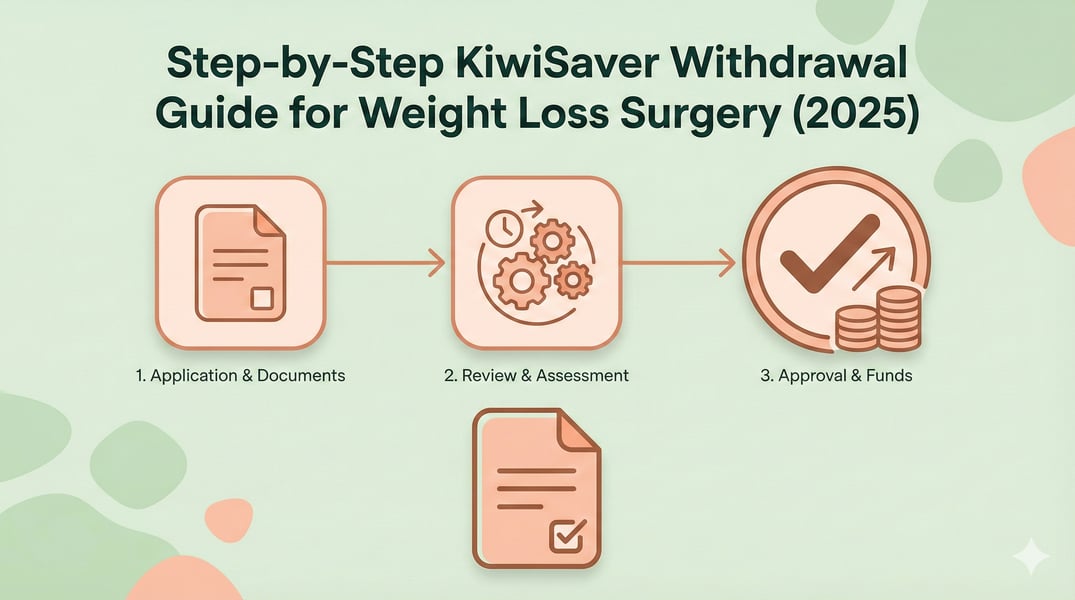
Step-by-Step KiwiSaver Withdrawal Guide for Weight Loss Surgery (2025)
Hülya Alkan · Dec 5, 2025 · Updated Oct 6, 2026
Using your KiwiSaver to fund weight loss surgery—such as a gastric sleeve, gastric bypass, or mini bypass is possible in New Zealand if you can prove medical necessity or financial hardship.
This guide walks you through every step of the process, from your first GP appointment to final approval.
It’s simple, clear, and specifically written for people applying for funding for bariatric surgery.
What Inland Revenue says (checked 1 October 2026): early KiwiSaver withdrawal for significant financial hardship can apply when you need to pay for medical treatment for yourself or a dependent family member, or if you have a serious illness. You apply to your KiwiSaver scheme provider; you only apply to Inland Revenue if you are within the first two months of your membership. Official rules: Getting my KiwiSaver savings for significant financial hardship · Getting my KiwiSaver savings early. This guide is general information, not financial or legal advice.
KiwiSaver providers require evidence that:
-
Your health is significantly affected by your weight
-
Your GP believes surgery is medically necessary
-
You have tried non-surgical treatments
-
Delay could worsen your health
Common qualifying conditions:
-
BMI ≥ 35
-
Diabetes
-
High blood pressure
-
Sleep apnea
-
Mobility issues
-
Heart-related risks
If you are unsure, book a GP appointment and ask whether surgery could be considered medically essential for your long-term health outcomes.
**Real Patient Example — Joy U.**
Many patients in our NewMe Bariatric Support community have successfully used KiwiSaver by clearly demonstrating medical necessity. One of them, Joy U., submitted a detailed GP letter that included her BMI, weight-related health risks, and her doctor’s recommendation for gastric sleeve surgery. This letter became the foundation of her application and helped Fisher Funds understand why the surgery was clinically necessary. Joy later shared that once her medical documentation was accepted, the rest of her process went smoothly.
**Another Real Case From Our Support Group – Sharlene’s Experience**
A recent conversation in our NewMe Bariatric Support Hub shows how strict KiwiSaver providers can be about medical necessity wording. One patient, Sharlene, shared that her application was delayed because her GP letter did not clearly state that gastric sleeve surgery was “essential” or “urgent.” Her provider responded that they could not proceed without a stronger medical justification. They also asked her to provide a new, clearer surgical quotation, as the initial one appeared faded and incomplete.
Other members replied with similar experiences. Sakura noted that her provider requested a quote specifically from a New Zealand surgeon, while another member explained that many NZ hospitals can issue a quote on official letterhead—including the patient’s name and date—without requiring a full consultation, as long as the patient says they are “exploring options.”
This real example highlights a key point: your GP letter must explicitly state medical necessity, and all documents—especially the quotation—must be clear, readable, and provided on an official letterhead. Missing or unclear details are one of the most common reasons applications are delayed or returned for revision.
Providers expect to see documentation that supports your case.
This usually includes:
✔ GP Medical Letter
Essential for all applications.
The GP should mention:
-
Your BMI
-
Your diagnosis
-
How your condition affects daily life
-
Why non-surgical treatments haven’t worked
-
Why surgery is recommended
-
Expected benefits
(See our GP Letter Template for a ready-made example.)
✔ Specialist Notes (if available)
Not mandatory, but very helpful—especially for Simplicity and Booster.
✔ Health Records
These may include:
-
Blood tests
-
Sleep study results
-
Diabetes metrics
-
Weight history
The stronger the medical evidence, the faster the approval.
KiwiSaver providers will only consider the exact amount needed for surgery, not your full balance.
You must include:
-
Type of surgery (sleeve, bypass, mini-bypass)
-
Total cost
-
Fees included (anaesthesia, theatre, hospital stay)
-
Clinic details and GST number
-
Payment deadline (if specified)
Most NZ clinics respond within 1–3 days.
Each provider has its own required forms.
Most forms include:
-
Medical withdrawal form
-
Hardship form (if applying under hardship criteria)
-
Statutory declaration
-
Identity verification requirements
Here are links to the main NZ providers:
-
Milford – medical withdrawal form
-
Booster – medical withdrawal form
-
Simplicity – hardship & medical forms
-
AMP – early withdrawal forms
-
ANZ – medical grounds withdrawal form
-
Fisher Funds – medical withdrawal form
(Requirements vary, but the overall process is similar.)
Your application must be complete. Missing documents cause the majority of delays.
A complete application includes:
-
GP letter
-
Clinic cost estimate
-
Photo ID
-
Bank statements (3 months) — hardship only
-
Income & expense summary — hardship only
-
Any specialist notes
-
Additional medical evidence
Tip: Combine all documents into a single PDF if possible to make your provider’s job easier.
**Community Tip for Faster Approval**
Several patients found that their applications were processed faster when they sent a full, well-prepared document package at the beginning. As one patient, Alisha, said:
“Attach as much paperwork as you can — it speeds up the process. The more documents, the less hassle, and it shows your provider that you’ve done all the work and this is your last resort.”
Not required, but highly effective.
A simple paragraph can explain:
-
Why surgery is necessary
-
How your condition affects your health
-
Why you need KiwiSaver to fund the procedure
-
That you have no alternative funding
Example:
“My weight is causing significant health issues, including hypertension and sleep apnea. Non-surgical treatments have not been effective. My GP considers surgery medically necessary. I am unable to afford the procedure without accessing my KiwiSaver.”
This helps humanise your application.
Most providers accept applications via:
-
Email
-
Provider portal upload
-
In-person drop-off (rarely needed)
Be sure to follow the provider’s checklist carefully.
Double-check before sending:
✔ GP letter included
✔ Full clinic quote attached
✔ ID verified
✔ Statutory declarations signed
✔ Hardship evidence included (if applicable)
Typical processing times in New Zealand:
-
Medical-only applications: 5–15 working days
-
Financial hardship applications: 10–20 working days
Delays happen when:
-
GP letter is too short
-
Documents are missing
-
Expenses/income breakdown isn’t clear
-
Provider asks for additional medical evidence
Follow-up is normal.
Providers may request:
-
Additional medical clarification
-
Updated bank statements
-
More detailed personal statement
-
Proof that loans/insurance aren’t viable
**Real Processing Times from NewMe Patients**
Members of our NewMe Bariatric Support Hub report a wide range of processing times, depending on the provider and how complete their documents were:
- **Karo T.** shared that her provider was experiencing high demand. Even after she sent everything, they asked for two more documents and told her that the longest wait would be around 10 working days.
- **Sakura** applied through Fisher Funds and was approved in about **15 days** for **20,000 NZD**, after submitting a clear GP letter, her surgery quote and financial information.
- Patients using **BNZ** often describe a three-step process: around 10 working days for the first response, another 5–10 days for supervisor review, and a further 5–10 days for payment. In total, their timeline is usually between **3 and 5 weeks**.
These real examples show why it’s important to apply early, allow extra time, and send a complete document package from the start.
KiwiSaver providers evaluate:
✔ Medical necessity
If your GP strongly supports the surgery, approval odds improve significantly.
✔ Evidence of hardship (if relevant)
They check whether surgery is affordable without KiwiSaver.
✔ Supporting documents
More complete = faster decision.
✔ Alternative funding sources
Providers must legally assess whether you could pay another way.
✔ Surgery cost transparency
Your clinic quote must be clear and final.
**What NewMe Patients Have Experienced with Different Providers**
Our community members have also noticed some differences between KiwiSaver providers in practice:
- **Fisher Funds** is one of the most commonly used providers and several patients reported comparatively fast responses once their GP letter and clinic quote were clear.
- **Public Trust** sometimes asks the clinic to confirm treatment details directly by email before releasing funds.
- **MAS (Medical Assurance Society)** can be more detailed in their assessment and may request additional medical documentation to support the case for surgery.
- **Generate** and other providers generally accept medical withdrawal applications, but they expect a strong GP report explaining exactly why surgery is essential and why other treatments have not worked.
These patterns are not official rules, but they reflect what real patients have experienced when applying for medical withdrawal to fund weight loss surgery.
Once approved:
-
Funds are transferred directly to the clinic
-
You will receive an approval letter
-
The surgery can be scheduled or confirmed
-
Your KiwiSaver account will update its balance
Approval letters usually state:
-
Amount released
-
Legal basis (medical withdrawal or hardship)
-
Any conditions
-
Timeline for payment
This is more common when:
-
Medical evidence was incomplete
-
GP letter lacked detail
-
Hardship wasn’t demonstrated
-
Provider believed alternative funding was possible
**Common Patient Mistakes We See**
When patients in our support group talked about declined or delayed applications, the same issues came up again and again: GP letters that didn’t clearly state that surgery was medically necessary, faded or incomplete clinic quotes, and missing financial documents. Most of these cases were resolved once the patient sent a stronger medical letter and a clearer, updated quote from their clinic or a New Zealand surgeon.
What you can do:
-
Strengthen your GP letter
-
Add missing documents
-
Provide clearer hardship evidence
-
Request a reconsideration
-
Switch to a different provider (not immediate, but possible long-term)
**What Patients Often Tell Us**
Some patients also tell us that their KiwiSaver journey includes additional steps they didn’t initially expect. For example, a few have shared that they were asked to confirm that public healthcare funding was not an option for them before their KiwiSaver application could proceed. In these cases, patients explained that once they provided confirmation that public funding was unavailable, their applications continued without further issues.
While this isn’t required for everyone, it’s a reminder that each KiwiSaver application is assessed individually, and additional documents may sometimes be requested along the way.
We have a full guide here:
KiwiSaver Hardship Withdrawal for Weight Loss Surgery →
12. Summary
Applying for a KiwiSaver withdrawal to fund bariatric surgery is absolutely possible in 2025 if:
-
Your GP confirms surgery is medically necessary
-
Your supporting documents are complete
-
Your financial situation justifies withdrawal (hardship route)
-
Your application is clearly presented
A well-prepared application dramatically increases your chances of fast approval.
Want personalised help checking your eligibility?
Thinking about your own journey?
Every patient comes to Turkey for a different reason. Tell us yours - your coordinator replies on WhatsApp.